
Most VC/PE teams have a backlog of small automations that would make their firms more efficient and informed. A quarterly Slack brief covering the deals a certain Partner has led. A check that flags anomalous KPIs before an LP consumes them. A tool that stress-tests fair valuations based on recent portfolio company progress. Each workflow is too small to justify buying bespoke software for, but now possible to automate with centralized portfolio data, some pre-planning, and modern LLMs.
Investment firms using Standard Metrics can build workflows like these easily through MCP—an open standard that lets AI tools plug into external systems in a controlled way—with the confidence that underlying data is structured, accurate, comprehensive, and clean. Company KPIs, investment data, Partner commentary, budgets, valuations and other portfolio data can all be synthesized in natural language once a MCP connection is set up. With the data problem solved, the only remaining question is what investment firms can build on top. Here are ten workflows that AI-native firms are building with Standard Metrics’ MCP.
1. Partner-tailored quarterly performance briefs
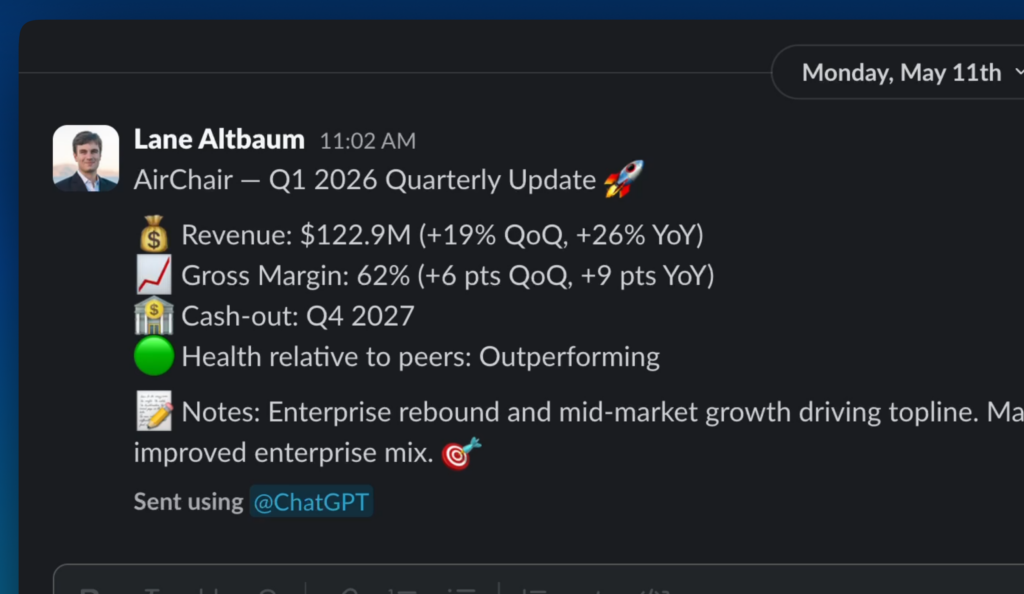
Asking Partners to comb through a detailed portfolio report every quarter can be a tall ask. The better approach is to push the signals that actually matter to them, focused on the deals each Partner is behind, in a format they can read between meetings. A simple MCP-powered workflow can pull the latest KPIs, budget-versus-actuals, financing updates, and qualitative updates for a specific investor’s portfolio companies. From there, it can generate a short brief that summarizes material changes: growth acceleration, burn deterioration, runway compression, budget misses, or notable qualitative updates. The first version can be simple: one paragraph, one Partner, every quarter. Over time, the brief can become more personalized based on their feedback.
See it in action: Summarize Portfolio Company Reports and Send Slack Briefings
2. Burn and runway alerts
Understanding capital at risk is crucial for reserve planning and portfolio support. An MCP-powered workflow can regularly check for newly submitted KPIs and alert the deal team when a company crosses a defined threshold: runway below 6 months, net burn above 25% month over month, or cash balance declining faster than expected. The workflow can compare the latest report against previous reports, its current budget, and or firm-defined thresholds. When something looks off, it can send a Slack message or email to the appropriate person at the firm.
See it in action: Schedule Runway Alerts
3. Board meeting prep automation
Before board meetings, an investor usually wants the same basic context: latest metrics, past commentary, budget performance, open questions, and anything that has changed since the last conversation. Too often, that prep requires jumping between previous board decks, notes, transcripts, email, and spreadsheets. Standard Metrics’ MCP can generate board meeting pre-reads with all this information in minutes. It can summarize the most recent financial metrics, highlight key deltas from the prior period, compare actuals against budget, pull past Partner commentary, pull in Affinity and Granola notes, data from your email, and even draft focused questions for the meeting. Investors are spared an hour or two, board conversations are sharpened, and investment teams are freed up to source and select more deals.
See it in action: Streamline Board Meeting Preparation
4. Quarterly beats and misses digest
Many firms collect company budgets but then have to manually review which companies beat or missed their plans. A quarterly beats-and-misses digest can compare actuals against forecasts and only surface the largest variances, positive or negative, for specific companies. Over time, this digest can help the firm spot investment opportunities, risks, and forecasting trends, like which companies are consistently off budget.
See it in action: Automate quarterly budgeted versus actuals analysis
5. Automate quarterly valuation memos
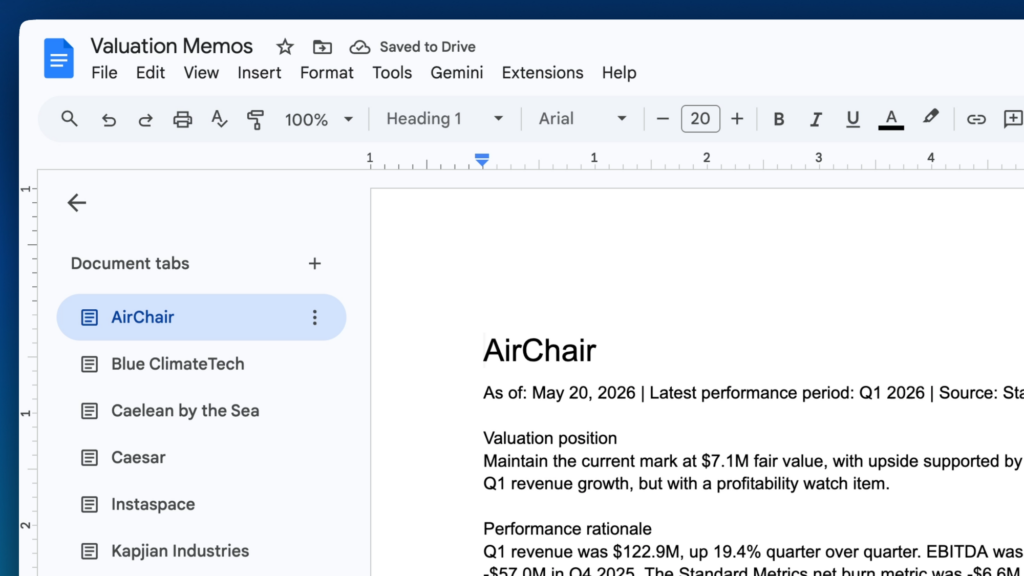
Most quarterly valuation work is data assembly and research. Investment firms synthesize KPIs, qualitative updates, recent financings, and comps, then write up a proposal before the debate about valuation can begin. An MCP-powered workflow can hand VC/PE teams a first-pass valuation for any company, automating the bulk of this work. Investment firm teams then spend time on the parts that actually require judgment.
See it in action: Bulk write valuation memos
6. Outperformance alerts
A company beating plan for multiple quarters, or showing a step-change in revenue growth, deserves IC attention. An MCP-powered automation can flag breakout portfolio company performance and send email alerts to your Partner, Platform lead, or Finance team with a brief note on which company is outperforming and why. This workflow surfaces breakouts early so firms gain signals on when it makes sense to pre-empt the next round.
See it in action: Flag Outperforming Portfolio Companies in Gmail
7. Diligence briefs using portfolio benchmarks
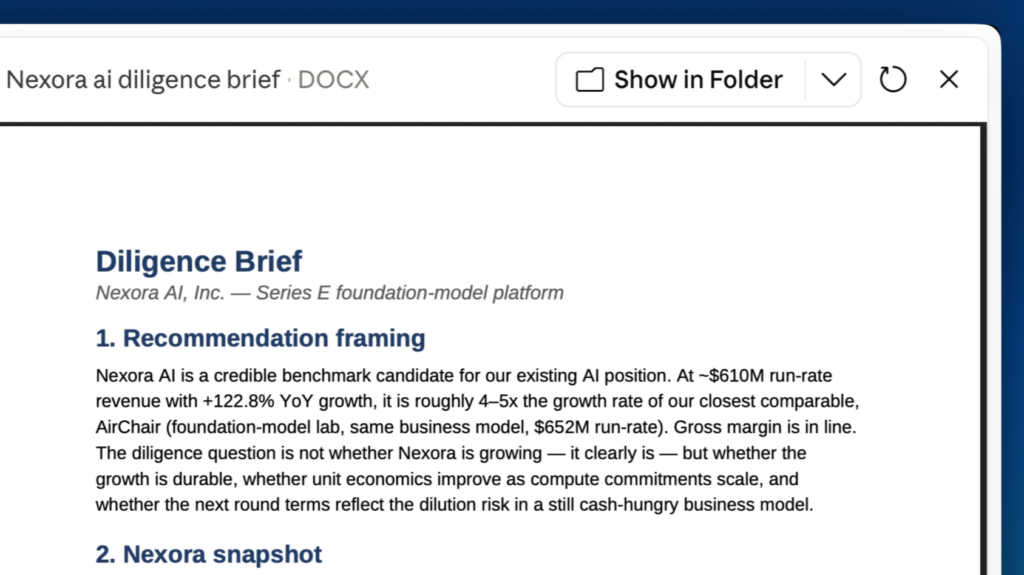
Benchmarking a deal’s financials against portfolio company performance is one of the fastest ways to spot the relative strengths, weaknesses, and red flags worth investigating further. It’s also one of the least common things to do early on: the data lives in different places, the comps take hours to build, and teams typically skip them in favor of market, founder, and product research. With Standard Metrics’ MCP, firms can ask how prospective deals stack up to portfolio company performance by sector and revenue tranche. Pull data from Granola and Affinity, or upload financials directly, and comps come back in seconds. Teams get a clear read on financial health to inform the rest of diligence.
See it in action: Streamline financial diligence with portfolio comps
8. Weekly portfolio news feed
Your portfolio companies are constantly in the news. A company announces a new round. A major customer win hits the press. An acquisition offer is reported. A weekly news scanner can monitor the web for mentions of portfolio companies, group the results by company, and surface material events like these. This data can complement what is tracked in Standard Metrics, enriching portfolio reviews, LP reporting, and more.
See it in action: Scan for portfolio news weekly
9. Warrant expiration reminders
Warrants can be easy to forget because they sit in securities data, spreadsheets, legal documents, or with your fund admin until someone thinks to read the fine print. But warrants are costly if not tracked and exercised on time. A lightweight, MCP-powered workflow can read securities data in Standard Metrics, identify warrants expiring in the next 30, 60, or 90 days, and notify the Finance team. This is exactly the kind of high-impact workflow AI is good at: narrow, rules-based, and sometimes overseen without automation.
See it in action: Schedule Warrant Expiration Alerts
10. Data quality auditor
Bad data quickly erodes GP and LP trust: whether that’s net burn reported as a positive number, ARR reported differently than the prior quarter, or quarterly figures that don’t tie out to annual totals. An MCP-powered data quality auditor can automate this review by running a standard set of questions against Standard Metrics and returning a triage list in minutes. A working version might look for period-over-period anomalies, areas where figures don’t tie out, or metrics that should be positive or negative. Finance and data teams still own the cleanup, but the tool gives them a data triage queue and helps prevent obvious issues from reaching Partners, LPs, or auditors.
See it in action: Audit Portfolio Data Quality
Conclusion
The workflows above are ideal for MCP because they draw on robust, structured data and do the narrow, scoped analysis tasks: summarizing, comparing, flagging, finding, or drafting. If a workflow stops being useful, it can be rebuilt or retired without compromising the underlying data. The rule that holds with any AI-driven workflow: verify outputs.
The Standard Metrics MCP Cookbook highlights more examples as well as real prompts, videos, and the tools required to execute them. If your team is new to MCP, start with the Standard Metrics MCP setup guide, connect your assistant, and pick a scoped workflow where you can test the output and make any changes before automations are scheduled. The best starting point is usually not the most ambitious one. It is simply the workflow everyone already wishes existed.
Automate your portfolio reporting
Find out how you can:
- Collect a higher volume of accurate data
- Analyze a robust, auditable data set
- Deliver insights that drive fund performance