
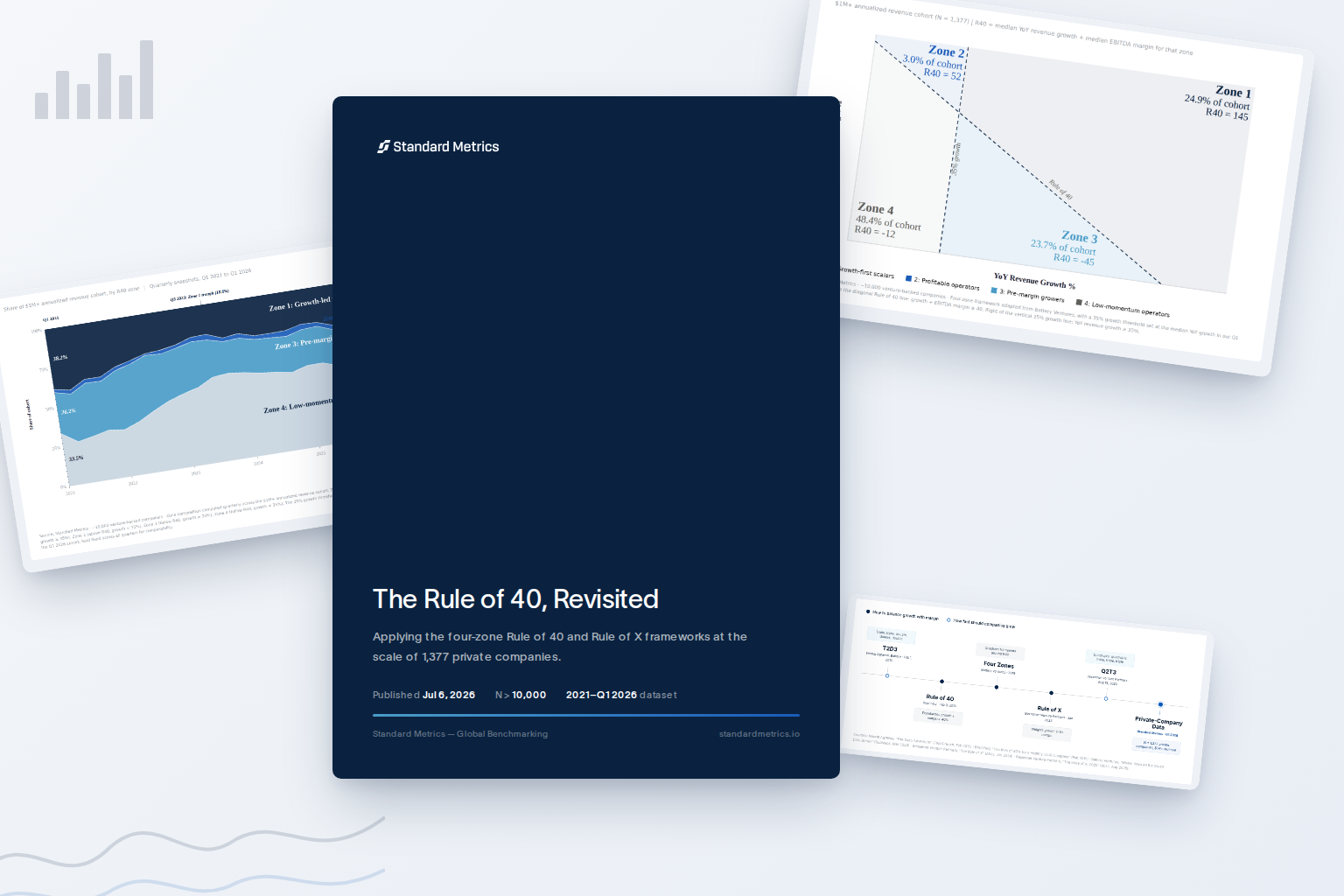
When private companies clear the Rule of 40, 89% of them do it through growth alone. Only 11% do it through balanced growth and margin — the profile the framework was originally designed to reward. That’s just one finding from our latest Private Market Report, focused on all things Rule of 40.

Every past analysis of the Rule of 40 was built on public data or small private portfolios. We ran it on 1,377 venture-backed private companies with $1M+ in annualized revenue. We examine where companies actually land across the four zones, how the distribution has shifted since 2021, what AI changes about the mechanics within each zone, and what the trajectory looks like as companies grow.

Excerpt

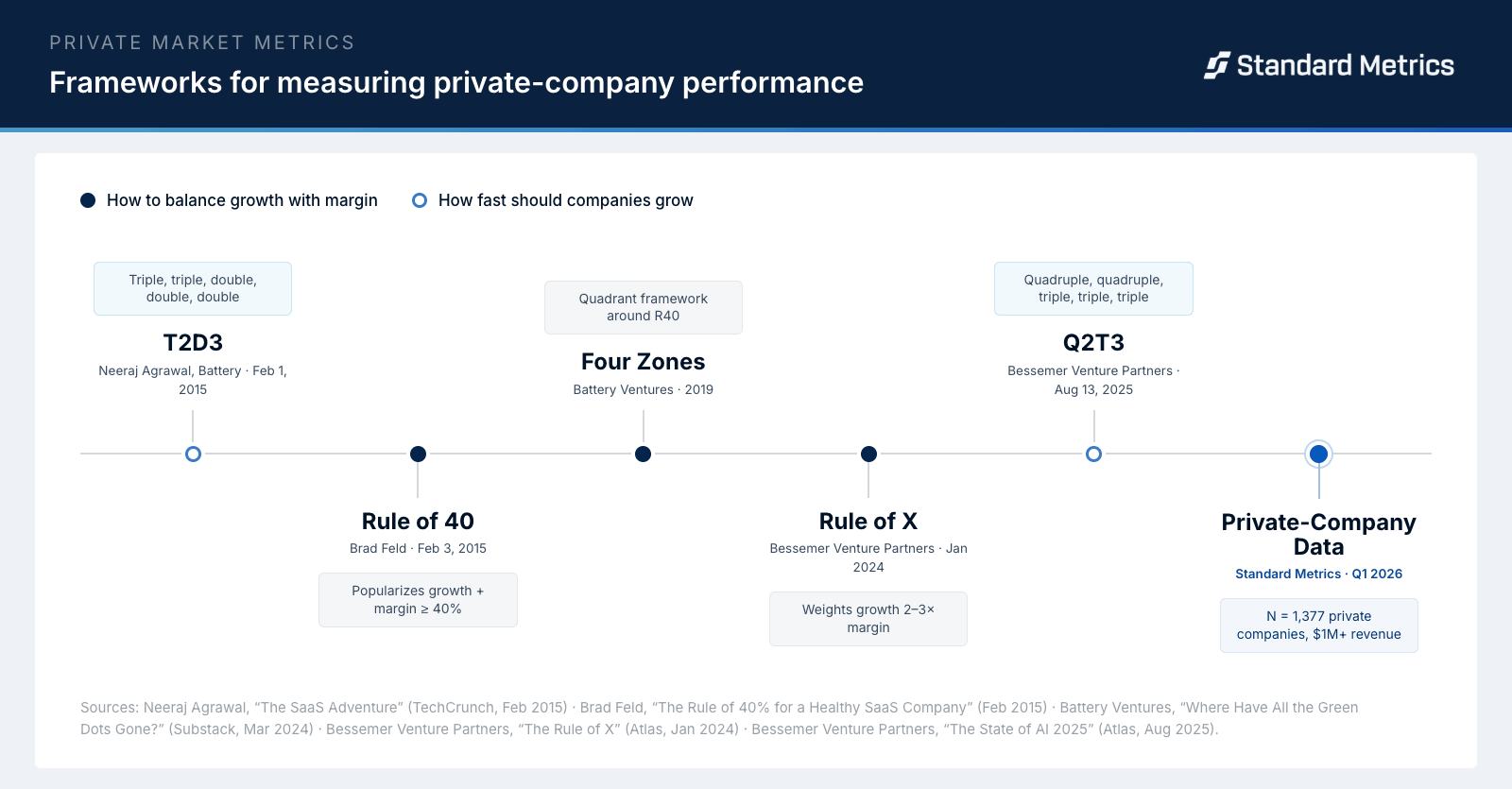
The Rule of 40 has been the default health check for software companies for a decade. Brad Feld popularized it in a 2015 post, framing it as a heuristic for late-stage SaaS: a company’s growth rate plus its profit margin should equal at least 40%. The rule caught fire: it was clean, memorable, and it put growth and profitability on the same scoreboard.

In 2019, Battery Ventures built on that idea with a four-zone framework. They split cloud companies by two questions: did they clear R40, and were they growing 30%+. Four quadrants, four colors, an easy way to track investor sentiment quarter over quarter.

Then in 2024, Bessemer argued the original math was wrong. Their analysis of cloud valuations showed growth was worth two to three times more than free cash flow margin. They proposed Rule of X, which weights growth before adding it to margin, and showed it had a stronger correlation with valuation multiples than R40.

Every iteration of this conversation has come from private-market investors, but the underlying analysis has run either on public data or on the smaller private-market datasets that individual firms can see through their portfolios. We haven’t seen this framework tested at the scale of 1,000+ private companies.

So we took it on for our latest Private Market Report.


Outline

Page 2

Introduction

Page 5

The four zones

Page 8

How the composition shifted, 2021–2026

Page 12

AI vs Non-AI: same zones, different mechanics

Page 16

Inside Zone 1 Growth-first scalers: scale buys margin, costs growth

Page 20

Inside Zone 3 Pre-margin growers: a different operating model

Page 23

A teaser into the Rule of X: a different lens for scaled companies

Page 24

Closing